

How To Read A Set Of Calipers
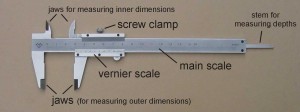
A quick guide on how to read a vernier caliper. A vernier caliper outputs measurement readings in centimetres (cm) and it is precise up to 2 decimal places (E.thousand. ane.23 cm).
Annotation: The measurement-reading technique described in this post will be similar for vernier calipers which output measurement readings in inches.
Measurement Reading Technique For Vernier Caliper
In gild to read the measurement readings from vernier caliper properly, you lot demand to remember ii things before we outset. For instance, if a vernier caliper output a measurement reading of 2.13 cm, this means that:
- The primary scale contributes the main number(s) and one decimal place to the reading (Due east.1000. 2.1 cm, whereby 2 is the chief number and 0.one is the one decimal place number)
- The vernier calibration contributes the second decimal place to the reading (E.g. 0.03 cm)
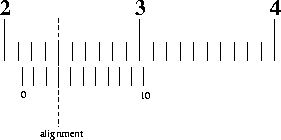
Let'due south examine the epitome of the vernier caliper readings to a higher place. We will but use a ii steps method to get the measurement reading from this:
- To obtain the chief calibration reading: Look at the epitome above, ii.1 cm is to the immediate left of the cypher on the vernier scale. Hence, the main calibration reading is 2.one cm
- To obtain the vernier scale reading: Await at the image higher up and look closely for an alignment of the scale lines of the primary calibration and vernier calibration. In the image higher up, the aligned line stand for to 3. Hence, the vernier scale reading is 0.03 cm.
In order to obtain the final measurement reading, we will add together the chief calibration reading and vernier scale reading together. This volition give 2.i cm + 0.03 cm = 2.xiii cm.
In a nutshell
Use the following formula:
$$ \text{Obtained reading} = \text{Main calibration reading} \, + \, \text{Vernier scale reading} $$
Allow's become through another example to ensure that yous sympathise the above steps:
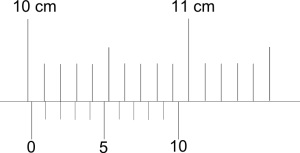
Primary scale reading: x.0 cm (Immediate left of nada)
Vernier scale reading: 0.02 cm (Alignment of scale lines)
Measurement reading: 10.02 cm
Compensating For Nil Error
In a nutshell
Utilize the following formula:
$ \text{Right reading} = \text{Obtained reading} \, – \, \text{Cypher mistake} $
where $\text{nothing mistake}$ can be either negative (the "0" of vernier scale is left of the "0" of the main scale) or positive (the "0" of vernier scale is correct of the "0" of the main calibration)
Explanation
Now, we shall attempt with zero error. If you are not familiar on how to handle zero error for vernier calipers, I advise that yous read upwardly on Measurement of Length.
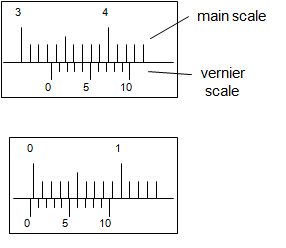
The reading on the meridian is the measurement obtained and the reading at the bottom is the zero error. Find the actual measurement. (Pregnant: become rid of the zero error in the measurement or take into account the zero error)
Measurement with zilch error: 3.34 cm
Nix mistake: – 0.04 cm (negative because the vernier scale is to the left)
Measurement without nil error: $3.34 \, – ( \, – 0.04) = 3.38$ cm
If you exercise non understand the subtraction of the negative cipher error from the measurement, please read on. Since the zero error is -0.04 cm, this ways that all measurements taken by the vernier calipers volition be SMALLER by 0.04cm. Hence, you will have to ADD 0.04 cm to ALL measurements in order to go the True measurement. The subtraction is done in the above case is to accept an elegant way of obtaining a resultant addition: $3.34 + 0.04 = 3.38$ and to go far COMPATIBLE with positive nix fault. This ways that in one case y'all have determined the nature of the nothing error (positive or negative), yous tin simply decrease the zero mistake and exist certain that your concluding answer is correct.
Consider a zero fault of +0.04 cm. With my method, $iii.34 \, – (+ 0.04) = 3.30$ cm.
Normal method: Since the goose egg error is +0.04 cm, this means that all measurements taken by the vernier calipers will be larger by 0.04 cm. Hence, y'all will have to Decrease 0.04 cm from ALL measurements in gild to get the true measurement. The final adding will be $3.34 \, – 0.04 = iii.30$ cm, which is the same equally my method.
Note: I hope that I did not confuse y'all. Drop a comment beneath if you encounter any difficulties.
More Vernier Caliper Practice:
- Without Cipher Fault
- Finding The Zero Error
- With Zero Error
- With Other Measurement Topics
Self-Exam Questions For Vernier Calipers
Where on the vernier calipers would yous read to obtain the main calibration reading?
Bear witness/Hide Answer
The main calibration reading is obtained from the reading on the principal scale that is at the firsthand left of the zero on the vernier scale.
Where on the vernier calipers would y'all read to obtain the vernier scale reading?
Show/Hide Answer
The vernier scale reading is obtained from the reading on the main scale that has analignment of the scale lines of the principal scale and vernier scale.
What is the smallest possible reading (in cm) of a vernier caliper?
Testify/Hide Answer
The smallest possible reading of a vernier caliper is 0.01 cm.
If you yet do not understand the concept, there is a very useful simulation of the vernier calipers: Vernier Caliper Simulation (Source)
Source: https://www.miniphysics.com/how-to-read-a-vernier-caliper.html
0 Response to "How To Read A Set Of Calipers"
Post a Comment